
 By Xanti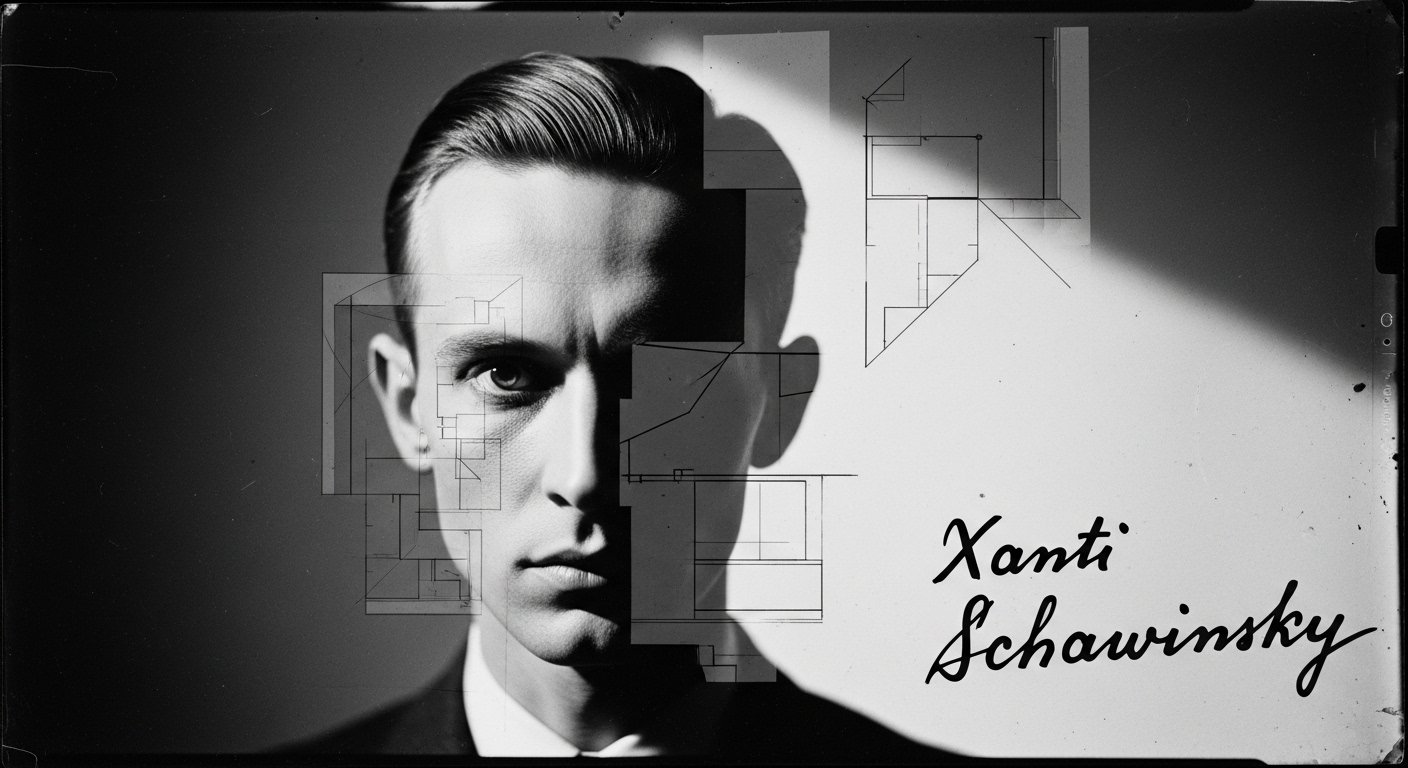
He was a painter, a photographer, a saxophonist, a set designer, and a graphic artist. He fled the Nazis, designed typewriters for Olivetti, and taught at a revolutionary college in the American South. If you have never heard of Xanti Schawinsky, it is not because he was minor—but because he was so multifaceted that he defies easy categorization.
Born Alexander Schawinsky in Basel, Switzerland, in 1904, “Xanti” was one of the most restless and radical talents to emerge from the Bauhaus circle. In an era that demanded artists specialize, Schawinsky refused to choose between art and commerce, the stage and the canvas, Europe and America.
The Bauhaus Apprenticeship
Schawinsky arrived at the Weimar Bauhaus in 1924, stepping into a crucible of creativity. He studied under the titans of modernism: Paul Klee, Wassily Kandinsky, and László Moholy-Nagy. But his true home was the stage department led by the enigmatic Oskar Schlemmer.
Unlike traditional theater, the Bauhaus stage was an laboratory of abstraction—concerned with space, color, light, and movement. Schawinsky thrived there, developing avant-garde pantomimes and skits. When the Bauhaus moved to Dessau, he picked up a saxophone to play in the student band and dove deep into experimental photography.
By 1927, he was not just a student but an assistant to Schlemmer, teaching stage design to the next wave of Bauhaus students.
The Graphic Wizard of Italy
The rise of the Nazi party forced the closure of the Bauhaus in 1933. As a Swiss artist of Polish-Jewish descent, Schawinsky saw the writing on the wall. He fled to Italy, where his career took a sharp—and iconic—turn.
In Milan, Schawinsky became a powerhouse of commercial design. Working with the legendary Studio Boggeri, he revolutionized Italian advertising. He brought the Bauhaus ethos of clean geometry and photomontage to the masses.
If you have seen a vintage poster for Cinzano, Illy coffee, San Pellegrino, or the Motta pastry shop, you have likely seen Schawinsky’s influence. His most famous industrial collaboration, however, was with Olivetti. Not only did he design some of the company’s most striking promotional posters using photomontage, but he also co-designed a marvel of industrial design: the Olivetti Studio 42 typewriter.
“Play, Life, Illusion” at Black Mountain College
In 1936, Schawinsky received a lifeline. Josef Albers, his colleague from the Bauhaus, invited him to join the faculty of Black Mountain College in North Carolina. This experimental school became a sanctuary for European refugees who would go on to change American art (including John Cage and Merce Cunningham).
It was here that Schawinsky created his magnum opus: “Play, Life, Illusion” (1937). He called it a “Spectodrama.”
Imagine a performance with no linear plot. Instead, it was a “total experience” installation concerned with light, sound, color, and bodies moving in 3D space. Schawinsky argued that the stage was not just for entertainment but a “laboratory for demonstration”—a way to study the fundamental phenomena of existence. Decades before the 1960s “Happenings,” Schawinsky was turning the classroom into a stage and the stage into a research lab.
Physical Painting: The Dance and the Automobile
Schawinsky’s insatiable need to experiment followed him into his late-career painting. In the late 1950s, he grew tired of the wrist-and-brush method. So he changed the tools.
He invented “Dance Painting.” He would attach blocks of paint to his feet, walk onto a canvas on the floor, and dance. The resulting works—such as Corrida (1956-1960)—captured the physical energy of the body in motion through spontaneous, random patterns.
When dancing became too slow, he scaled up. In 1959, he created “Track Paintings.” He replaced his body with a car. Driving over prepared canvases, he allowed the tire treads to imprint themselves on the surface, creating intersecting tracks that symbolized uncontrolled motion and the brute force of mid-century technology.
Key Milestones of Xanti Schawinsky
| Period | Location | Key Activity |
|---|---|---|
| 1924-1925 | Weimar Bauhaus | Student of Klee, Kandinsky & Schlemmer |
| 1927 | Dessau Bauhaus | Assistant Teacher for Stage Design |
| 1929-1931 | Magdeburg | Head of Graphics for the City Building Authority |
| 1933-1936 | Milan, Italy | Graphic designer for Olivetti & Illy; creates iconic posters |
| 1936-1938 | Black Mountain College | Devised “Play, Life, Illusion” (Spectodrama) |
| 1956-1960 | Lake Maggiore | Develops “Dance Painting” technique |
Conclusion
Xanti Schawinsky was a man perpetually ahead of his time. He was a graphic designer who elevated advertising to modern art, a painter who abandoned the brush for the dance floor, and a theatre practitioner who invented performance art before it had a name. His legacy has been complex to trace, partly because his greatest work was not always the object left behind, but the experience of the classroom and the performance—ephemeral moments that nevertheless changed American art forever.
Schawinsky believed that art in its totality could be achieved through the mobilization of the human body and the invention of new tools. By fleeing the totalitarianism of Europe and planting the seeds of the avant-garde in the fertile soil of America, he served as a crucial bridge between European modernism and the experimental art of the post-war era. He reminds us that true creativity is not about mastering a single medium, but about the fearless, playful, and endless search for truth across all of them.
In 2021, the Kunstmuseum Magdeburg held a major retrospective titled “Xanti Schawinsky – From the Bauhaus Into the World,” finally giving this nomad the solo spotlight he deserved.